Autor: Pinheiro

  • Article 90 of Law 23/2007: Misinterpretations in different SEF offices

    Article 90 of Law 23/2007: Misinterpretations in different SEF offices

    Article 90 of Law 23/2007 | SEF | Portugal

    Article 90 outlines the conditions that must be fulfilled to obtain a residence permit for highly qualified activities in Portugal:

    a) Have a work contract or service agreement compatible with teaching or highly qualified activities.

    b) Present an invitation letter issued by an educational or vocational training institution.

    c) Provide a statement of responsibility from a certified company, as defined by the relevant government departments responsible for internal affairs and the economy.

    d) Be collaborating in a cultural activity carried out in the national territory as part of a project recognized by the government department responsible for cultural affairs as being in the country’s interest.

    According to the information provided, only one of the conditions needs to be met. The condition varies depending on the specific situation and the interpretation of this article may differ among different SEF (Serviço de Estrangeiros e Fronteiras) offices in Portugal.

    Some SEF offices, such as those in Lisbon (Setubal, Evora and all under Lisbon jurisdiction) and have stricter interpretations and may require additional certifications, such as IAPMEI certification, even if the applicant fulfills the condition mentioned in letter “a” of the article.

    The problem is: when SEF employees does not know what they are doing, they usually call the Lisbon office for “guidance”. Because of this, the Madeira Autonomous Region (which apparently is following Lisbon interpretation).

    On the other hand, SEF offices in the northern region (like Porto and Braga)  interpret the law correctly and do not impose additional certification requirements.

    It is important to note that the specific requirements and interpretations may vary based on the SEF office and their regional guidelines.

    Therefore, individuals seeking a residence permit under Article 90 should always consult an experienced lawyer.

    The safest option is always take a lawyer with you in your interview/appointment, so you can ensure the enforcement of the law.

    Thiago Vieira, lawyer in Portugal, dedicated to Immigrant Law
    and in the Law of Foreigners
    (talk to this lawyer: click here)

    tags: SEF, Portugal, article 90, highly qualified activities .

  • What is a court expert? Digital Law in Portugal

    What is a court expert? What does an expert in information technology do in a lawsuit?

    An expert is a person appointed by the court or the parties in order to provide his expertise on a certain subject during court proceedings. Their duty is to the court even if the parties have appointed the expert.

    Usually, national laws lay down the duties and responsibilities of experts. Most countries stipulate requirements (education, training and/or certification) for recognition as an expert in court proceedings. Currently, there is no agreement between the Member States on the requirements for (judicial) experts and national nomenclatures significantly differ from one another.

    There are many types of experts:

    • An expert witness will be asked to interpret facts and/or give an opinion based on their expertise in technical matters or on their experience so as to clarify the parties’ arguments;
    • A technical expert will be asked to give their opinion on technical or scientific issues;
    • A legal expert may be consulted about rules, practices and rights applicable to foreign law;
    • Other experts.

    The national factsheets on experts and expertise provide information about existing national lists and registers of experts, requirements experts have to adhere to, remuneration and liability of experts, as well as information about the conduct of expert proceedings.

    These national factsheets have been compiled by the European Expert and Expertise Institute (EEEI) within the framework of the Find an Expert project, funded under the Justice Programme of the European Commission.

    Source: European e-Justice

  • Court expert in Portugal | Digital Law

    Judicial expert in digital law lawsuits (information technology)

    A court expert, also known as a court-appointed expert or judicial expert, is a professional with specialized knowledge and expertise in a particular field who is appointed by the court to provide expert opinions or advice in a legal case. Unlike a party-hired expert who works for one of the parties involved in the case, a court expert is appointed by the judge and serves as an impartial and independent advisor to the court.

    The expert must act according to his area of expertise. For example, in Portugal, we have Thiago Vieira, who is a judicial expert in digital law, with extensive experience in information technology issues.

    The role of a court expert is to assist the court in understanding complex technical, scientific, or specialized matters that are relevant to the case. The court expert’s opinion or report is intended to provide an objective and expert analysis of the issues at hand and help the court make informed decisions based on reliable and accurate information.

    The appointment of a court expert can occur in various types of legal cases, such as civil litigation, criminal proceedings, or administrative hearings. The court expert may be asked to evaluate evidence, conduct investigations, perform analyses, or provide expert testimony during the trial or hearing. Their role is to assist the court in reaching a fair and just resolution based on their professional expertise.

    It’s important to note that the specific procedures for appointing and utilizing court experts can vary between jurisdictions and legal systems. However, the overarching purpose of a court expert remains consistent: to provide the court with specialized knowledge and opinions to aid in the resolution of a legal matter.

    Adriano Pinheiro, lawyer in Portugal

    tags: expert proof, court expert, forensic report, expert, court expert, questions .

  • Digital Law in Portugal | Specialist Lawyer

    Digital law, also known as cyber law or internet law, refers to the legal principles and regulations that govern activities conducted online or in the digital realm. It encompasses a broad range of legal issues related to the internet, digital technology, and electronic communications.

    You can schedule an appointment online with a lawyer specializing in digital law – Click Here.

    Digital law covers various aspects, including but not limited to:

    Privacy and data protection: Laws and regulations that govern the collection, use, storage, and sharing of personal information online. This includes regulations like the General Data Protection Regulation (GDPR) in the European Union.

    Intellectual property: Legal frameworks that protect copyrights, trademarks, patents, and other intellectual property rights in the digital sphere. These laws address issues such as online piracy, digital content distribution, and infringement.

    Cybercrime: Laws that address criminal activities committed online, such as hacking, identity theft, fraud, cyberbullying, online harassment, and cyberterrorism. These laws aim to protect individuals, organizations, and governments from digital threats.

    E-commerce and online contracts: Regulations governing electronic transactions, online contracts, consumer rights, online advertising, and electronic signatures. These laws ensure the enforceability and fairness of digital transactions.

    Internet governance: Legal frameworks related to the management and regulation of the internet, domain names, internet service providers (ISPs), and online content. These laws aim to maintain stability, accessibility, and accountability in the digital environment.

    Jurisdiction and cross-border issues: Legal principles that determine which laws apply when activities or disputes occur across different jurisdictions. These laws address challenges related to online activities that transcend national boundaries.

    Digital law is a constantly evolving field, as technology and the digital landscape continue to advance. Governments, international organizations, and legal experts work to adapt existing laws and develop new regulations to keep pace with the ever-changing digital environment.

    Adriano Martins Pinheiro, lawyer in Portugal

    digital law, lawyer, attorney at law, portugal .

  • How to get an appointment at SEF? Immigrants in Portugal

    How to get an appointment at SEF? Immigrants in Portugal

    It has been impossible for a long time to get an appointment at the SEF | June 2023.

    We know that it is necessary to make an appointment with the SEF in order to get a residence permit. As a rule, the only way to get this appointment is through the SEF call center (the number has recently changed). Therefore, the immigrant must call and ask for the respective appointment.

    However, there are rarely any spots available. This is without considering the hours of waiting and numerous attempts to actually get through to the call center. Sometimes it is simply impossible to get through. Incredibly, there is no solution.

    The call center is the only form of service for such cases. Therefore, not even lawyers can solve the issue. In other words, a lawyer would also have the same problems trying to get an appointment, i.e. he would spend hours trying to get an appointment and, finally, he would be told that there are no slots available.

    The exception is for the expression of interest procedure, because the slots are informed by email. Besides, those who arrived in Portugal with a visa already have an automatic appointment to go to the SEF (in theory).

    In short, the only solution is for the Portuguese government to invest in the structure responsible for attending to immigrants. It is necessary to invest in hiring staff and in the development of efficient systems to facilitate and speed up the procedures. Without investment, there is no solution. The demand has grown a lot and there hasn’t been a proportional investment.

    We must remember that Portugal is receiving more and more immigrants. People from all over the world are immigrating to Portugal; and the demand only grows. Thousands of families arrive from countries like Brazil, India and China. Because they are populous countries, the tendency is to arrive more and more. As already said, the problem is the lack of Portuguese investment to meet the demand. This is because, if the country intends to receive immigrants, it must create the conditions for this.

    Finally, we know that the SEF is in the process of extinction and the Agency for Integration, Migrations and Asylum (AIMA) is being created. Therefore, many changes are happening and the future is uncertain. The only option is to observe. Until now (June 2023), there are thousands of immigrants suffering the consequences of illegality, without residence permits and subject to marginalization and miserability.

    Author: Adriano Martins Pinheiro, a lawyer in Portugal, writer and international consultant.

    (mais…)
  • How to open a company in Portugal (main steps)

    How to open a company in Portugal (main steps)

    Our office offers the service of opening a company in Portugal. Basically, the client will only need to provide the necessary documents (sent in a list).

    To open a company in Portugal, it is necessary to follow some steps:

    Company name: You will need to choose a name for the company. It is important to check that the name chosen is not already registered by another company. Before you register a company name, you must ask for a certificate that guarantees that you can use that name.

    Commercial registration: The company must be registered at the National Register of Legal Entities (RNPC). After registration, the company will obtain the “Legal Entity Identification Number” (in Portuguese: “Número de Identificação de Pessoa Coletiva” – NIPC).

    Choice of legal form: The interested party must choose the legal form of the company, which can be a private limited company (LDA), a public limited company (SA), or an individual entrepreneur (ENI). The choice of legal form should be the one that best suits the needs of the interested party. Therefore, the guidance of a lawyer is strongly recommended (check that it is a professional who actually has a registration number in Portugal – Portuguese Bar Association).

    Preparation of the by-laws: The company must have its by-laws, which are a set of internal rules that define its structure and operation. Again, legal assistance is recommended to ensure that the statutes are in accordance with Portuguese law.

    Share capital: The company must have the share capital, according to the legal form chosen. To do so, it must deposit the respective amount in a bank account in the company’s name.

    Obtaining licenses and permits: Depending on the industry in which the company operates, it may be necessary to obtain additional approvals. You will therefore need to check whether your business activity requires specific licenses or permits.

    Social Security and Tax Registration: The company must be registered with the Social Security in Portugal as an employer. In addition, the company must also be registered with the Portuguese Tax and Customs Authority for tax purposes (Finanças). These registrations are mandatory for companies in Portugal.

    Hiring personnel: If the company plans to hire employees, it must fulfill the legal obligations regarding labor contracts, social contributions and health insurance.

    Opening a business bank account in Portugal: The company must have a bank account for business and financial purposes.

    Adriano Martins Pinheiro, lawyer in Portugal.

    tags: company in portugal, opening a company in portugal, how to open a company in portugal, businessman, power of attorney, lawyer, law firm, in english .

  • Criminal Record Certificate in Portugal: Issuing and Apostille

    Criminal Record Certificate in Portugal: Issuing and Apostille

    Criminal Record Certificate in Portugal: How to request, consult and apostille

    In short, our team of professionals apostille the criminal record certificate and send it to the country of your choice.

    Therefore, the order will be:

    Step 1: Our office issues the criminal record certificate;
    Step 2: After the certificate has been issued, we arrange for it to be apostilled;
    Step 3: We ask the courier company (DHL) for a quote on the cost of shipping to the client’s country.
    Step 4: The client pays the shipping costs.
    Step 5: The firm sends the document by post and gives the tracking code to the client so that they can follow the progress of the delivery.

    Some important details about the above steps:

    How do I issue a criminal record certificate?

    As a rule, the person concerned is outside Portugal and needs to have their criminal record certificate apostilled. In this case, there are two options:

    PLACE YOUR ORDER NOW | CLICK HERE

    Option 1 – Criminal record certificate access code:

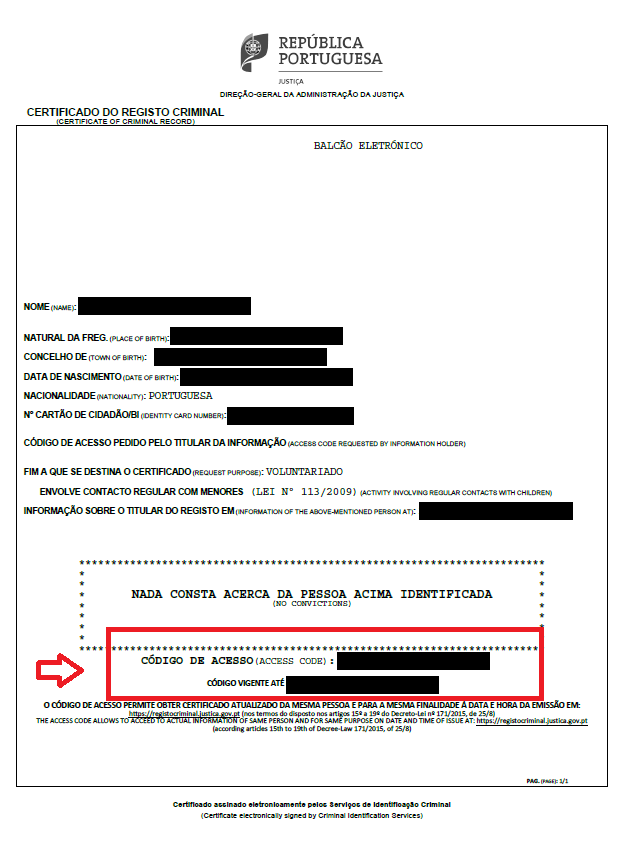
    The interested party sends a copy of the criminal record certificate to the office (by email or Whatsapp). This certificate has a 12-digit access code. In possession of this access code, the office issues a new certificate and arranges for it to be apostilled.

    Note: You can issue a criminal record certificate yourself. Simply apply online on the “Online Criminal Record” platform. However, the client must have a “citizen’s card” or “digital mobile key”.

    This option is quicker and cheaper, as the lawyer prints out the certificate in the office and takes it to the apostille (a diligence).

    Option 2 – Declaration of authorization:

    If the client does not have a criminal record certificate with access code, the lawyer will need to make a request in person. To do this, the lawyer will need to receive a statement of authorization signed by the client (the client must send the following by post: statement of authorization + copy of passport).

    In short, the lawyer will not be able to obtain a criminal record certificate for a person if he or she does not have the original authorization statement. This is because the criminal record is a highly confidential document and it is not possible to give this information to just anyone.

    In this case, the lawyer will need to do two things:

    • the lawyer makes the request for issuance in person (by handing in the declaration of authorization) at a certain department;
    • takes the document for apostille – to another department.

    Note that option 2 requires two acts from the lawyer. Therefore, there will be an additional fee. If the client already has the access code, the lawyer will only do one act – which makes the procedure cheaper.

    CLIQUE HERE

    How to request the certificate through the Online Criminal Registry

    To request the certificate of criminal record online, the interested party should access the site “Criminal Record Online”
    authenticate himself with his Citizen Card or with the Mobile Digital Key, fill out the form and make the payment corresponding to the certificate.

    Public service fee (not to be confused with lawyer’s fees)

    The Portuguese government charges:

    • Issuing the criminal record certificate ….: 5€
    • Apostille of the certificate …………………..: 10,20€

    Total expenses

    The customer must consider as an expense:

    • The above public service fees;
    • Office fees for providing the service;
    • Postage costs (e.g. DHL).

    Sending the document / Post

    We can’t tell you the cost of sending the document. We will ask the company (e.g. DHL) for a quote once we have the document apostilled and ready to send. The cost varies according to the weight and destination address.

    The delivery time is the responsibility of the courier company. The client will receive a “tracking code” to follow the progress of the delivery.

    Lawyer’s fee proposal

    We will send you a fee proposal by email. Make your request: pinheiro@advocaciapinheiro.com

    Author: Adriano Martins Pinheiro, Lawyer in Portugal

    tags: certificate, criminal record, criminal certificate, nothing found, Portuguese, portugal, apostille, apostille, lawyer, online .

  • Smartest people seek expert advice

    The smartest people seek expert advice.

    The reason is that smart individuals understand their limitations and recognize that they may not have all the knowledge and expertise needed to make the best decisions in every situation. Therefore, they seek out advice and guidance from experts in particular fields when faced with a problem or challenge.

    Smart people tend to have a growth mindset, meaning they are open to learning and seek out new information and perspectives. They understand that seeking expert advice can provide valuable insights, help them avoid mistakes, and increase their chances of success.

    Furthermore, seeking expert advice on a case-by-case basis allows individuals to tailor their approach to the specific situation at hand. Different situations may require different types of expertise, and seeking advice from experts in those areas can help individuals make the best decisions.

    In summary, smart people seek expert advice on a case-by-case basis, as they recognize their limitations and are willing to seek out advice and guidance to make informed decisions and increase their chances of success.

    Adriano Martins Pinheiro

    tags: expert, advice, lawyer, attorney at law, portugal ...

  • How important is it to consult a lawyer? (Portugal)

    Consulting a lawyer can be very important in many situations, especially those involving legal matters. Lawyers are trained professionals who are familiar with the law and can provide legal advice and guidance on a wide range of issues.

    Here are some situations where consulting a lawyer can be particularly important:

    Starting a business: A lawyer can help you navigate the legal requirements for starting a business, including drafting contracts, registering trademarks, and setting up a legal structure for your business.

    Real estate transactions: A lawyer can help you with buying or selling a property, reviewing contracts, and resolving any legal disputes that may arise.

    Family law matters: A lawyer can provide legal advice and representation for issues such as divorce, child custody, and adoption.

    Criminal defense: A lawyer can provide legal representation if you are facing criminal charges, helping you navigate the legal system and protecting your rights.

    Personal injury claims: A lawyer can help you file a personal injury claim, negotiate with insurance companies, and pursue compensation for your injuries and damages.

    Consulting a lawyer can be important not only for addressing specific legal issues but also for preventing legal problems in the first place. A lawyer can review contracts and legal documents, identify potential issues, and provide guidance on how to protect your legal rights and interests.

    However, it is worth noting that hiring a lawyer can be expensive, and not everyone may be able to afford legal representation. Nonetheless, many lawyers offer free or low-cost consultations, and some legal organizations provide pro bono services for those who cannot afford to hire a lawyer.

    tags: attorney at law, lawyer, portugal, advice, consulting ...

  • EB-2 | Employment-based immigrant visa category in the United States

    EB-2 is a type of employment-based immigrant visa category in the United States. It is intended for foreign nationals who possess advanced degrees or exceptional ability in their field of work.

    To qualify for an EB-2 visa, the applicant must have at least a Master’s degree or a Bachelor’s degree plus five years of progressive experience in their field. Alternatively, they may show exceptional ability in the sciences, arts, or business, which must be demonstrated through sustained national or international acclaim and recognition.

    EB-2 visa applicants must also have a job offer from a U.S. employer who is willing to sponsor their visa. The employer must also obtain a labor certification from the U.S. Department of Labor to show that there are no qualified U.S. workers available for the position.

    EB-2 visas are subject to annual numerical limits, which means that the number of visas available in this category may be limited in a given year. However, EB-2 visa holders can eventually apply for permanent residency (green card) and eventually become U.S. citizens if they meet the eligibility requirements.

    There are two types of EB-2 visas:

    EB-2 (NIW) – National Interest Waiver

    This type of EB-2 visa allows foreign nationals who have exceptional ability in their field or an advanced degree to waive the job offer and labor certification requirements. Instead, the applicant must show that their work will be in the national interest of the United States.

    To qualify for the National Interest Waiver, the applicant must demonstrate that their work has substantial merit and national importance, and that they are well-positioned to advance the proposed endeavor. They must also show that it would be beneficial to waive the job offer and labor certification requirements, and that they are likely to continue working in their field in the United States.

    EB-2 (Non-NIW) – Employer Sponsored

    This type of EB-2 visa requires a job offer from a U.S. employer who is willing to sponsor the foreign national for permanent residency. The employer must also obtain a labor certification from the U.S. Department of Labor to demonstrate that there are no qualified U.S. workers available for the position.

    To qualify for the EB-2 (Non-NIW) visa, the foreign national must have either an advanced degree or a bachelor’s degree plus five years of progressive experience in their field. They must also demonstrate exceptional ability in their field, which can be shown through sustained national or international acclaim and recognition.

    Overall, both types of EB-2 visas are intended for individuals who possess advanced degrees or exceptional ability in their field and have a job offer from a U.S. employer. However, the National Interest Waiver allows for a waiver of the job offer and labor certification requirements for those who can demonstrate their work will be in the national interest of the United States.

    tags: united states, us, visa ...