Autor: Pinheiro

  • Apostilla de La Haya: qué es y cómo funciona

    Apostilla de La Haya: qué es y cómo funciona

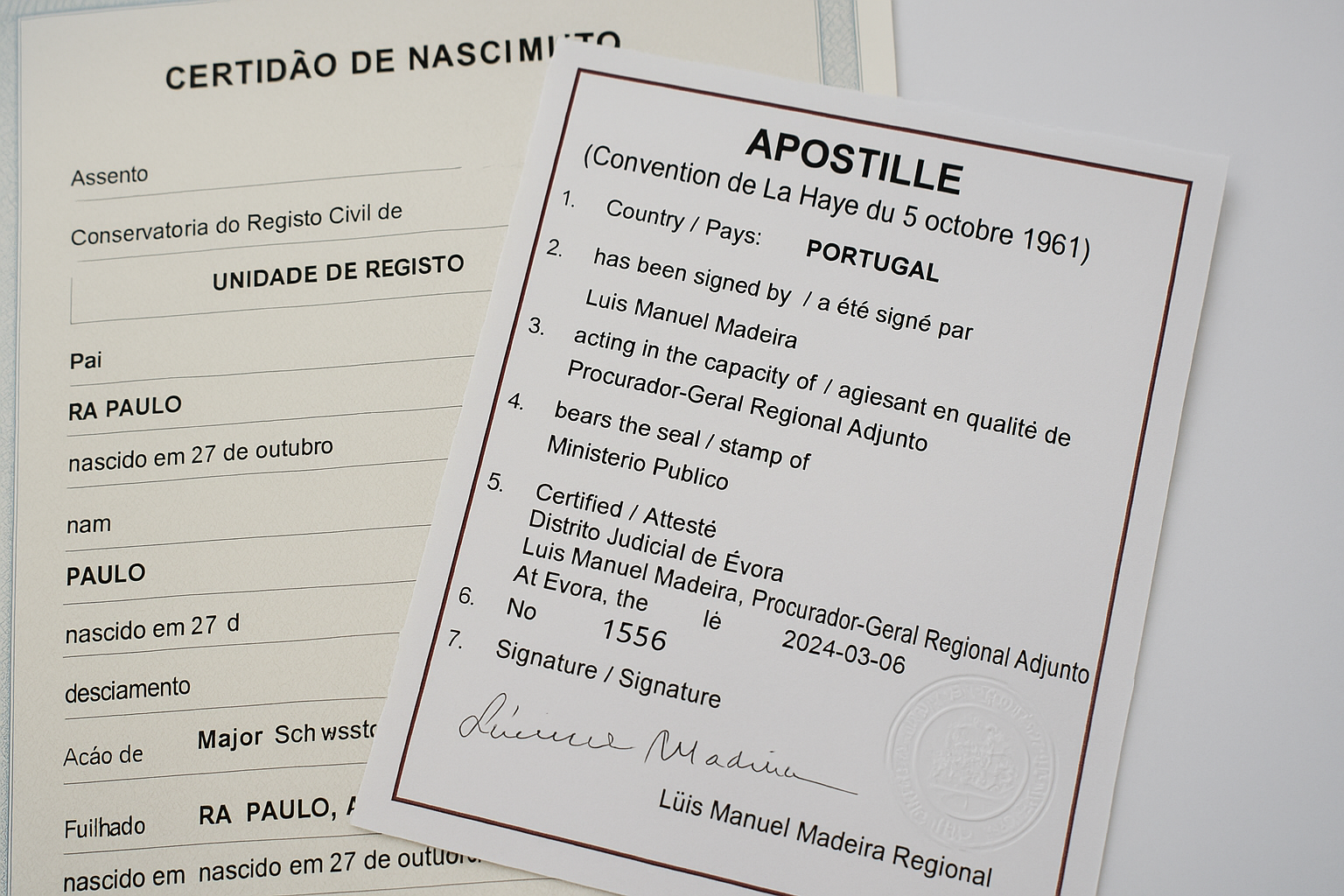
    La Apostilla de La Haya es un certificado emitido por una autoridad competente de un país firmante del Convenio de La Haya del 5 de octubre de 1961. Este certificado autentica el origen de un documento público, otorgándole validez legal en otro país miembro. El proceso de apostilla reemplaza la legalización consular tradicional y simplifica el reconocimiento internacional de documentos.

    Proceso de apostilla de La Haya en Portugal

    En Portugal, la Apostilla de La Haya es emitida por los Procuradores Generales Regionales del Ministerio Público. El proceso comienza con la obtención del documento oficial en la entidad emisora y finaliza con la colocación de la apostilla.

    Apostilla de certificados de nacimiento, matrimonio o defunción

    Estos documentos son emitidos por el Instituto dos Registos e do Notariado (IRN). Una vez obtenida la certificación, debe presentarse ante una Procuraduría General Regional (por ejemplo, en Lisboa o Porto), donde se aplica la Apostilla de La Haya y se adjunta al documento.

    REALIZA TU APOSTILLA CON NOSOTROS

    Apostilla de certificados de antecedentes penales

    El certificado de antecedentes penales es emitido por la Dirección General de la Administración de Justicia (DGAJ) y contiene un código para verificación en línea. Con el documento en mano, debe presentarse ante el Ministerio Público para aplicar la Apostilla de La Haya, validando su uso en el extranjero.

    Una vez apostillado, el certificado es válido en todos los países firmantes del Convenio de La Haya.

    ¿Para qué sirve la Apostilla de La Haya?

    La apostilla permite que documentos públicos sean reconocidos legalmente en otros países sin necesidad de legalización en consulado o embajada. Esto facilita trámites legales, académicos y administrativos en el extranjero.

    Documentos comunes que requieren la Apostilla:

    • Certificados de nacimiento: para procesos de nacionalidad, residencia o matrimonio;

    • Certificados de matrimonio: para reagrupación familiar o inscripción matrimonial;

    • Certificados de defunción: en trámites de herencia o pensiones;

    • Certificados de antecedentes penales: solicitados para visados, trabajo o residencia.

    ¿Se puede apostillar un documento en un país diferente al de emisión?

    No. El documento debe ser apostillado en el mismo país donde fue emitido. Un certificado portugués debe ser apostillado por autoridades portuguesas. Lo mismo aplica para documentos de otros países.

    ¿Por qué cada país debe emitir su propia apostilla?

    La Apostilla de La Haya certifica la autenticidad de la firma, el cargo del signatario y el sello oficial. Solo el país emisor tiene competencia para verificar y validar oficialmente estos elementos.

    ¿La apostilla reemplazó la legalización consular?

    Sí. En los países que forman parte del Convenio de La Haya, la apostilla reemplaza por completo la legalización consular o diplomática. Un documento portugués apostillado es válido en países como Brasil, Francia, Alemania y España. Si el país de destino no es parte del convenio, aún se requiere legalización consular.


    ¿Necesitas una Apostilla de La Haya para documentos portugueses?

    Ofrecemos un servicio profesional de apostilla en Portugal, incluyendo certificados de nacimiento, matrimonio, defunción, antecedentes penales y otros documentos oficiales. Nos encargamos de todo el proceso de forma segura y enviamos los documentos apostillados por correo internacional a cualquier país.

    Contáctanos hoy mismo y simplifica tu trámite de apostilla con rapidez y confianza.
    Adriano Martins Pinheiro, Abogado en Portugal

  • Hague apostille: what is it and how does it work?

    Hague apostille: what is it and how does it work?

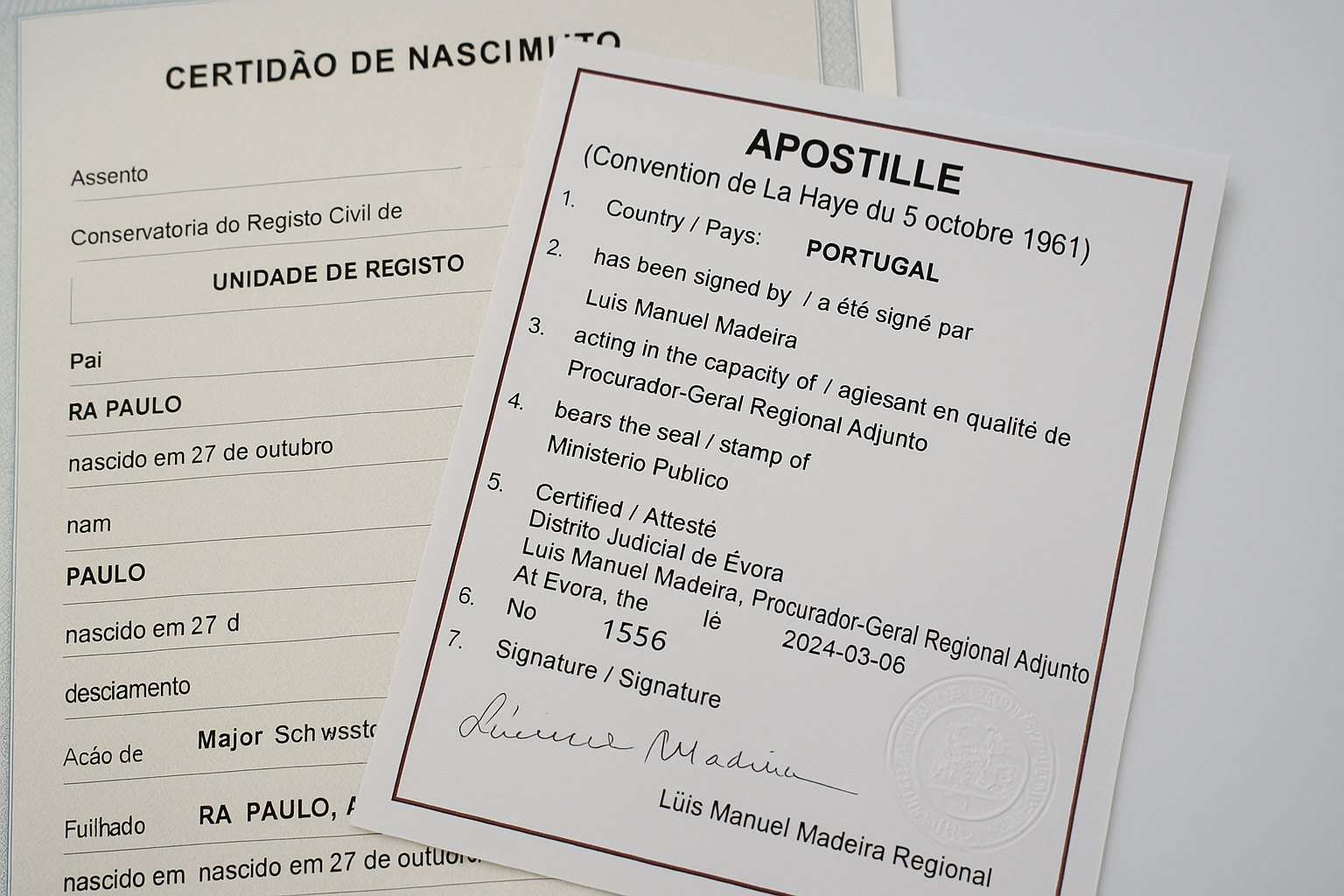
    The Hague apostille is a certificate issued by a competent authority of a country that is part of the Hague Convention of 5 October 1961. It authenticates the origin of a public document, making it legally valid in another member country. This process, called apostille, simplifies the legalization of public documents for international use, replacing the traditional consular route.

    How is the Hague apostille done in Portugal?

    In Portugal, the Hague apostille is issued by the Regional Prosecutors General of the Public Prosecutor’s Office. The process begins with obtaining the document from the issuing entity and ends with the apostille being affixed.

    Example 1: Apostille of birth, marriage or death certificates

    These certificates are issued by the Instituto dos Registos e do Notariado (IRN). Once issued, the applicant must go to one of the Regional Prosecutors General Offices (e.g., Lisbon or Porto), where the Hague apostille is attached to the document.

    GET YOUR DOCUMENTS APOSTILLED WITH US

    Example 2: Apostille of criminal record certificates

    The criminal record certificate is issued by the criminal identification services of the Directorate-General for the Administration of Justice (DGAJ) and includes an access code for online verification. The document must then be taken to a Regional Prosecutor General Office for apostille, confirming its origin for international recognition.

    Once apostilled, the criminal record certificate is valid in all countries under the Hague apostille convention.

    What is the Hague apostille used for?

    The apostille allows public documents to be recognized in other countries without consular or embassy legalization. It streamlines legal, administrative, academic, and professional procedures abroad.

    Common apostilled documents:

    • Birth certificates: for nationality, residence, or marriage abroad;

    • Marriage certificates: for family reunification or registration;

    • Death certificates: in inheritance or pension matters;

    • Criminal record certificates: required for visas, work, or residency.

    Can a document be apostilled in a different country?

    No. A document must be apostilled in the same country where it was issued. A Portuguese certificate, for example, must be apostilled by Portuguese authorities. The same rule applies globally.

    Why must each country issue its own apostille?

    The Hague apostille certifies the authenticity of the signature, role of the signatory, and official seal. Only the country that issued the document has the authority to verify and certify these elements.

    Did the apostille replace consular legalization?

    Yes. In countries that are signatories of the Hague Convention, the Hague apostille replaces consular or diplomatic legalization. Apostilled documents from Portugal are valid in countries like Brazil, France, Germany, and Spain. If the destination country is not a member, consular legalization may still be required.


    Need a Hague apostille for documents from Portugal?

    We provide professional apostille services in Portugal for birth, marriage, death certificates, criminal record certificates, and more. We handle the full process securely and ship apostilled documents internationally by mail.

    Contact us today and simplify your apostille process with confidence and convenience.

    Adriano Martins Pinheiro, Lawyer in Portugal

  • CIPLE for Portuguese Nationality – Complete Guide

    CIPLE for Portuguese Nationality – Complete Guide

    The CIPLE for Portuguese nationality is the A2 level language exam required by Portuguese law as a condition for naturalization. CIPLE stands for Certificado Inicial de Português Língua Estrangeira, and it evaluates your basic Portuguese communication skills.

    If you are a foreign national aiming to apply for Portuguese nationality, passing the CIPLE is often mandatory, as outlined in Article 25 of the Nationality Regulation (Decreto-Lei n.º 237-A/2006).


    What Does the CIPLE Exam Include?

    The CIPLE exam (level A2 of the CEFR) measures basic proficiency in the Portuguese language. It covers:

    • Reading comprehension

    • Listening comprehension

    • Written interaction

    • Oral interaction

    These are tested through three sections that simulate real-life communication scenarios. The goal is to show that you can handle simple, everyday Portuguese conversations and situations.


    Who Should Take the CIPLE for Portuguese Nationality?

    Anyone applying for:

    • Portuguese nationality

    • Permanent residence in Portugal

    …may need to prove their language ability with the CIPLE for Portuguese nationality, unless they are exempt (e.g., citizens of Portuguese-speaking countries).

    Exams are open to people aged 16 or older, regardless of how or where they learned Portuguese.


    When and Where to Take the CIPLE Exam?

    The CIPLE exam is offered in May, July, and November, both in Portugal and abroad. You can take it at certified exam centers associated with CAPLE (Centro de Avaliação de Português Língua Estrangeira).

    CIPLE-P is the version offered specifically in Portugal.

    To register, visit:
    🔗 https://caple.letras.ulisboa.pt


    Talk to a lawyer – Click here

    Why the CIPLE for Portuguese Nationality Matters

    Failing to provide a valid language certificate can lead to your nationality request being rejected — sometimes two years after submission. And if you used a non-recognized course, it may be too late to act.

    That’s why it’s critical to choose official pathways, such as:

    • Public Portuguese universities

    • Camões Institute centers abroad

    • IEFP and Qualifica Centres

    • CAPLE-authorized institutions


    Most Reliable Options to Meet the Language Requirement

    To ensure your certificate is valid for Portuguese nationality, prefer these:

    1. CIPLE (A2) exam by CAPLE

    2. Certified courses from public education institutions or IEFP/Qualifica

    3. Camões Institute-approved centers (especially for those abroad)

    Avoid private institutions unless they have a protocol with public entities, as required by law (Portaria n.º 183/2020).


    Final Tips

    • Always check if the course or certificate provider is listed by IEFP or CAPLE.

    • Don’t assume all Portuguese courses are valid — verify before enrolling.

    • Keep proof of enrollment and certification in safe digital format.


    If you’re unsure whether the course you found qualifies for CIPLE for Portuguese nationality, reach out to:

    • Instituto Camões

    • CAPLE

    • IEFP (Instituto de Emprego e Formação Profissional)

    • Centro Qualifica in your area


    Adriano Martins Pinheiro, lawyer in Portugal

    • Always check if the course or certificate provider is listed by IEFP or CAPLE.


  • How to Safely Prove Your Portuguese Language Skills for Nationality or Residency

    How to Safely Prove Your Portuguese Language Skills for Nationality or Residency

    The Safest Paths to Avoid Problems

    If you are applying for Portuguese nationality or permanent residence, proving your knowledge of the Portuguese language is a legal requirement. But beware: if your certificate is not valid, you may only find out two years later, when the IRN (Instituto dos Registos e do Notariado) denies your application — and by then, the school may no longer exist or be held accountable.

    To avoid this risk, the safest path is to choose public institutions or officially recognized and accredited entities. Below, we explain your options, the legal requirements, and how to make sure your course and certificate will be accepted.


    Most Reliable Institutions (Recommended)

    Choose institutions that are publicly recognized or accredited by the Portuguese State:

    • Public universities and polytechnic institutes in Portugal

    • Camões Institute (Instituto Camões)

    • IEFP – Instituto do Emprego e Formação Profissional

    • Qualifica Centers (Centros Qualifica)

    These entities offer courses that lead to valid certificates, and they are supervised directly by the Portuguese government.


    Legal Requirements for Portuguese Language Proof

    According to Article 25 of Decree-Law No. 237-A/2006, as amended, the following documents are accepted as proof of knowledge of the Portuguese language:

    • School certificate confirming completion of Portuguese language classes in a recognized institution (in Portugal or abroad);

    • Certificate of completion of a Portuguese Language for Integration course (A2 level or higher) issued by public schools, IEFP centers, or Qualifica centers;

    • CIPLE Certificate (Certificado Inicial de Português Língua Estrangeira) obtained through an official exam;

    • Other accredited certificates equivalent to A2 or above, issued by institutions under agreement with the government.

    ⚠️  Some private schools offer online courses claiming that their certificate is valid without requiring the official CIPLE exam. Although this is possible, you must ensure that the institution is truly authorized and that the certificate follows the current legal requirements.


    How to Verify the Validity of the Course or Certificate?

    Before enrolling or paying for any course, we recommend taking the following steps:

    1. Ask for the legal basis the school uses to say the certificate is valid — for example, “according to Article 25 of Decree-Law No. 237-A/2006…”.

    2. Request proof that the course is:

      • Offered by a public entity; or

      • Homologated (recognized) by the IEFP or a public school, as required by Article 9(3) of Ordinance No. 183/2020.

    3. Consult the Qualifica Portal (www.qualifica.gov.pt) or contact:

      • IEFP

      • Camões Institute

      • General Directorate of Education (DGE)

      • Agency for Qualification and Vocational Education (ANQEP)

    These bodies can help confirm if a course is recognized.


    Summary: What You Should Do

    • Choose public or officially recognized institutions.

    • Do not rely only on the school’s claim — ask for legal and documentary proof.

    • Be careful with offers that avoid the official CIPLE exam — verify the certificate’s legal value.

    • Make sure the course is at least 100 hours and includes level A2 of the Common European Framework of Reference for Languages (CEFR).

    • Save everything: invoices, contracts, course plans, and communication.


    By following these steps, you can move forward safely and confidently on your path to Portuguese nationality or permanent residence — without unpleasant surprises in the future.

    Adriano Martins Pinheiro, Lawyer in Portugal

  • Divorce transcription in Portugal: quick and practical guide

    Divorce transcription in Portugal: quick and practical guide

    If you’re looking for information about divorce transcription in Portugal, this guide will help you understand the steps you need to take to have your foreign divorce legally recognized.

    Whether you’re a Portuguese citizen, a resident, or a foreign national who was divorced abroad, you may need to transcribe your divorce in Portugal to update your marital status in the civil registry. This is essential for legal matters like remarrying, property division, or obtaining nationality for your children.


    What is divorce transcription in Portugal?

    The term divorce transcription refers to the official legal process of recognizing a foreign divorce. Portugal does not automatically recognize divorces that occurred outside the country, even if the marriage was already registered there.

    To ensure your marital status is updated in Portuguese civil records, a formal legal process is required.


    When do you need divorce transcription in Portugal?

    You must request divorce transcription if:

    • Your divorce was finalized in another country, and

    • You need that divorce to be recognized in the Portuguese system (e.g. for updating civil status, remarrying, etc.)

    This applies to people of any nationality who have ties to the Portuguese legal system, such as residence, dual nationality, or registration of marriage in Portugal.

    📞 Need assistance? Contact us – click here


    Divorce transcription vs. marriage transcription

    Transcribing a marriage is generally a straightforward administrative procedure. However, divorce transcription is more complex because it involves recognizing a foreign court decision or public document, which must be validated by a Portuguese court.


    How is divorce transcription in Portugal done?

    To complete divorce transcription, you must file a lawsuit called recognition of foreign judgment (ação de homologação de sentença estrangeira) before the Portuguese Court of Appeal (Tribunal da Relação).

    Once the court approves the foreign divorce decision, it officially updates the Portuguese civil registry.


    Required documents for divorce transcription

    A lawyer will provide a tailored checklist, but generally you will need:

    • Divorce decree or certificate (apostilled)

    • Certified translation (if not in Portuguese)

    • Marriage certificate

    • Birth certificates (if applicable)

    • Power of attorney for legal representation

    All documents issued abroad must be apostilled in the country of origin and translated into Portuguese by a certified translator.


    Costs and processing time

    Here’s what to expect when requesting divorce transcription:

    • Court fees: €306 to €612, depending on case complexity

    • Legal fees: Vary by lawyer

    • Timeline: 2 to 6 months, depending on documentation and court load


    Why you need a lawyer for divorce transcription in Portugal

    This is a judicial process that legally requires an attorney. A lawyer will:

    • Draft and file the court petition

    • Verify and prepare your documents

    • Handle all communication with the court

    • Ensure timely registration of your divorce in civil records

    Choosing a lawyer familiar with international family law ensures faster and safer processing.


    Final thoughts on divorce transcription in Portugal

    No matter your nationality or country of residence, if you divorced abroad and want that divorce to be legally effective in Portugal, you must complete the divorce transcription process.

    This legal step guarantees your personal and civil records are updated, giving you full legal certainty for future actions.

    Need help? Contact a specialized lawyer to get started.

    Adriano Martins Pinheiro, lawyer in Portugal

  • AIMA address change: request residence card reissue online

    AIMA address change: request residence card reissue online

    The AIMA address change and the request for a second copy of the residence card can now be completed online. This new feature allows immigrants in Portugal to update personal information and speed up essential administrative procedures.

    How the AIMA address change works

    AIMA has created a specific section on its official portal where foreign citizens can submit an AIMA address change request, as well as update civil status or gender identity. To begin, users simply provide their email address and complete the online form.

    Required documents

    To validate the AIMA address change or request a duplicate residence card, applicants must:

    • Submit a scanned copy of their passport and residence card;

    • Upload proof of any changes (e.g., address, civil status);

    • For duplicate requests, attach the police report (known in Portugal as “participação policial”).

    Important deadlines

    The AIMA address change request must be submitted no later than 90 days before the expiration date of the current residence card. For those whose residence is valid until June 30, 2025, the final date for submission is April 1.

    Past issues and caution regarding effectiveness

    Before this measure, many foreign nationals in Portugal faced serious challenges when trying to update basic information. Securing an in-person appointment with AIMA often took several months.

    In some cases, immigrants were forced to hire lawyers and file lawsuits just to obtain a duplicate residence card. The ability to now perform the AIMA address change online is, therefore, a significant step forward.

    However, there remains skepticism about the platform’s reliability. AIMA has previously launched digital services that did not function as expected. Only time will tell if this new online system will consistently meet the needs of foreign residents.

    Conclusion

    The AIMA address change process and the request for a duplicate residence card are now digital, faster, and more convenient. While the move is positive, it remains to be seen whether the platform will prove effective in practice.

    Adriano Martins Pinheiro, lawyer in Portugal

  • Portuguese Community in the United States: A Rich and Enduring Legacy 🇵🇹 🇺🇸

    Portuguese Community in the United States: A Rich and Enduring Legacy 🇵🇹 🇺🇸

    The history of the Portuguese community in the United States is rich and multifaceted. Today, it is estimated that over 1.3 million people of Portuguese descent live in the U.S., including direct immigrants and multi-generational Luso-Americans. This diaspora originates from various historical periods and regions of Portugal, with a strong presence along both the East and West coasts of the country.

    An Ancient Historical Connection with the Portuguese Community in the United States

    The relationship between Portugal and the United States is long-standing and significant. Portugal was the first neutral country to recognize American independence shortly after the Revolution. The first documented Portuguese presence in the U.S. dates back to 1634, with Sephardic Jew Mathias de Sousa, considered the earliest known Portuguese in colonial America.

    Even earlier, in the early 16th century, Portuguese explorers Miguel Corte Real and João Rodrigues Cabrilho explored parts of North America and California, leaving historic traces such as the Dighton Rock in Massachusetts.

    During the colonial period, small groups of Portuguese settlers in the U.S. established communities on islands like Martha’s Vineyard and Nantucket, mainly dedicating themselves to fishing.

    Migration Patterns of the Portuguese Community in the United States

    The effective emigration of Portuguese citizens to the United States intensified in the 19th century, particularly among Azoreans and Madeirans. These immigrants established vibrant communities in New England, especially in cities such as:

    • New Bedford, Fall River, and Taunton (Massachusetts)

    • Providence and Pawtucket (Rhode Island)

    • Newark (New Jersey)

    On the West Coast, many Portuguese residents in the United States settled in California, particularly in San José, San Diego, and the agricultural regions of the Central Valley. Active communities were also formed in Hawaii, Oregon, and Washington.

    The Azores Refugee Act and Growth in the 20th Century

    A significant milestone was the Azores Refugee Act of 1958, introduced by John F. Kennedy following the eruption of the Capelinhos volcano in the Azores. This act facilitated the entry of hundreds of Azorean families into the U.S., setting a precedent for future migration waves.

    The Immigration Act of 1965 further increased the legal entry of Portuguese immigrants, especially throughout the 1970s and 1980s. Many newcomers worked in sectors such as fishing, the textile industry, agriculture, and local commerce.

    Today’s Community: Numbers and Distribution

    According to the 2000 U.S. Census and updated estimates, over 1.3 million people of Portuguese origin reside in the United States. Here are the states with the highest concentrations:

    • California: 330,974 (1% of state population)

    • Massachusetts: 279,722 (4.4%)

    • Rhode Island: 91,445 (8.7%)

    • New Jersey: 72,196 (0.9%)

    Portuguese communities are found in nearly every U.S. state, with hundreds of clubs, associations, and cultural centers preserving Portuguese heritage.

    The Cultural Legacy of the Portuguese Community in the United States

    Among the most remarkable cultural contributions of the Portuguese in the U.S. are:

    • The ukulele, a popular instrument in Hawaii, which originated from Madeira.

    • Composer John Philip Sousa, son of a Portuguese immigrant, known for his famous patriotic marches.

    • Linguistic and toponymic influences in areas with strong Portuguese presence.

    Portuguese surnames were often anglicized:
    Silva → Silver, Rodrigues → Rogers, Madeira → Wood, among others.

    🇵🇹 A Legacy That Lives On

    The history of the Portuguese in the United States reflects resilience, integration, and pride in their roots. Over the centuries, this community has not only grown in number but also developed a unique identity—both Portuguese and American.


    ✉️ Need to Legalize Portuguese Documents for Use in the U.S.?

    Our law firm, based in Portugal, provides apostille services for Portuguese documents, with DHL delivery to the United States. We serve Luso-American citizens and their descendants at all stages of document legalization.

    CLICK HERE

    Adriano Martins Pinheiro, Attorney in Portugal

  • Birth Certificate Translation and Apostille in Portugal – Full Legal Service

    Birth Certificate Translation and Apostille in Portugal – Full Legal Service

    A birth certificate translation and apostille in Portugal is required when presenting a Portuguese birth certificate in another country. You must follow a specific legal procedure to ensure that the document is valid internationally. This includes issuing the birth certificate, translating it into English, and obtaining an apostille. As a lawyer in Portugal, I handle the entire process, ensuring a fast, secure, and legally valid service.

    Step 1: Obtaining the Birth Certificate from the Civil Registry

    The process begins with the lawyer requesting an official birth certificate from the Civil Registry Office in Portugal (Conservatória do Registo Civil). This is a legally issued document that will serve as the basis for the certified translation.

    Once issued, the lawyer receives the original birth certificate in hand, which is necessary for the next steps.

    Step 2: Certified Translation of the Birth Certificate

    After obtaining the birth certificate, the lawyer proceeds with the official translation into English. This translation is done with legal accuracy and must reflect all details of the original document.

    Once completed, the lawyer certifies the translation by issuing a Translation Certificate, which confirms the accuracy and authenticity of the translation.

    Step 3: Apostille of the Birth Certificate and Certified Translation

    With both documents ready (the original birth certificate and the certified translation), the lawyer proceeds to the apostille process.

    How is the Apostille Done?

    • The original birth certificate and the certified translation are stapled together, making them a single document.
    • A single apostille seal is applied to the set, confirming its authenticity for international use.

    This process ensures that both the birth certificate and its translation are officially recognized in any country that is a signatory to the Hague Convention.

    REQUEST YOUR CERTIFIED TRANSLATION – CLICK HERE

    Step 4: Sending the Apostilled Document to the Client

    After the apostille is completed, the lawyer sends the final document via postal mail to the client’s country. The document is now legally valid for use abroad, whether for immigration, legal, or administrative purposes.

    Can This Process Be Applied to Other Documents?

    Yes! The same procedure can be applied to other official documents, including:

    • Marriage Certificates – Required for legal marriage registration or immigration purposes.
    • Death Certificates – Needed for inheritance claims, legal proceedings, or international estate matters.
    • Criminal Record Certificates – Frequently required for visa applications, residency permits, or employment abroad.

    If you need any of these documents translated, certified, and apostilled, the process follows the same legal steps, ensuring official international recognition.

    Why Choose a Lawyer for Birth Certificate Translation and Apostille in Portugal?

    Complete Legal Service – The lawyer handles the entire process, from document issuance to final delivery.
    Official Recognition – The translation and apostille are legally valid worldwide.
    Fast and Secure – The entire process is handled professionally and efficiently.
    International Compliance – The apostille ensures recognition in all Hague Convention countries.

    Need a Birth Certificate Translation and Apostille in Portugal?

    If you need your birth certificate translation and apostille in Portugal, contact me for a fast, legal, and hassle-free service.

    Adriano Martins Pinheiro is a lawyer based in Portugal, offering online legal services to clients worldwide.

  • Certified Translation by Lawyer in Portugal – Official Service

    Certified Translation by Lawyer in Portugal – Official Service

    What is a Certified Translation by a Lawyer in Portugal?

    A certified translation by a lawyer in Portugal is a service authorized by law, allowing lawyers to certify translations of documents. This procedure is officially recognized and can be carried out through the “Online Registry of Lawyers’ Acts” platform.

    Who Can Perform a Certified Translation in Portugal?

    Lawyers registered with the Portuguese Bar Association have the legal competence to certify translations, granting them official validity. This service is essential for those who need to present documents to foreign institutions.

    REQUEST YOUR CERTIFIED TRANSLATION – CLICK HERE

    The Only Form of Certified Translation in Portugal

    It is crucial to emphasize that this is the only legally recognized form of certified translation in Portugal. There is no other official method. There is no requirement or possibility to involve embassies or consulates in this process.

    If you need a legally valid translation in Portugal, it must be certified by a lawyer or notary. Any other procedure will not be recognized by Portuguese authorities or international institutions requiring certified translations from Portugal.

    Practical Example of a Certified Translation

    If an individual requires a certified translation for a birth certificate, they can contact a lawyer. The document will be translated and certified via the official platform, ensuring its authenticity and international acceptance.

    Certified Translation vs. Sworn Translation

    It is important to note that in Portugal, there is no concept of sworn translation or sworn translator. The correct term is certified translation, performed by a lawyer, giving it legal validity.

    Hague Apostille and International Validity

    In addition to certification, the lawyer can also arrange for a Hague Apostille, allowing the certified translation to be accepted in countries that are signatories to the Hague Convention.

    Legal Basis for Certified Translation by a Lawyer in Portugal

    Certified translation by lawyers is based on Portuguese legislation:

    • Article 38 of Decree-Law No. 76-A/2006, of March 29 – Allows lawyers to officially certify translations.
    • Ordinance No. 657-B/2006, of June 29 – Defines the administrative procedures for translation certification by lawyers.

    Advantages of a Certified Translation by a Lawyer in Portugal

    Speed and Efficiency – The process is digital and streamlined.
    Official Recognition – Translations accepted by all national and international entities.
    Hague Apostille – Possibility of international validation.

    Need a Certified Translation?

    Contact us to get your certified translation quickly, securely, and with official recognition!

    Adriano Martins Pinheiro is a lawyer based in Portugal, assisting clients worldwide through online services.

  • How to Get Married in Portugal: A Complete Guide

    How to Get Married in Portugal: A Complete Guide

    Are you planning to get married in Portugal? Understanding the legal and administrative process is essential to ensure everything goes smoothly. This guide will explain step by step how to get married in Portugal, covering all the necessary documents, costs, and procedures.

    1. Types of Marriage in Portugal – How to Get Married in Portugal

    If you are wondering how to get married in Portugal, you must first choose the type of marriage:

    • Civil marriage: Conducted at a Civil Registry Office or another authorized location.
    • Catholic marriage: Celebrated according to the rules of the Catholic Church, with subsequent registration at the Civil Registry.
    • Civil marriage in religious form: Conducted by other religious denominations recognized by the Portuguese State.

    GETTING MARRIED IN PORTUGAL? WE CAN GUIDE YOU – CLICK HERE FOR LEGAL SUPPORT!

    2. Who Can Initiate the Marriage Process in Portugal?

    The marriage process in Portugal can be initiated by:

    • The couple themselves;
    • A legally appointed representative, such as a lawyer.

    3. How to Start the Process to Get Married in Portugal

    The first step in getting married in Portugal is to submit a declaration of intent to marry at the Civil Registry Office. At this stage, the couple must provide the following information:

    • Type of marriage (civil, Catholic, or civil in religious form);
    • The location where they wish to get married in Portugal;
    • The chosen property regime;
    • The desired date and time for the ceremony.

    4. Required Documents to Get Married in Portugal

    The couple must present the following documents:

    • Identification documents (Citizen Card or Passport);
    • Residence Permit (for foreigners);
    • Birth certificate (for foreigners, if required);
    • Certificate of prenuptial agreement, if applicable.

    If one of the parties is represented by a proxy, the power of attorney must:

    • Be an authenticated document;
    • Contain specific powers for the act;
    • Indicate the identity of the spouse and the chosen property regime;
    • Specify the type of marriage.

    5. Deadlines and Possibility of Objection to Getting Married in Portugal

    The marriage must take place within six months after process approval.
    During this period, any person may file an objection, citing legal impediments.
    If the objection is accepted, the couple will be notified and may appeal the decision.

    6. Civil Registry Fees to Get Married in Portugal

    The cost of getting married in Portugal is €120. Additional costs may apply depending on factors such as:

    • Ceremony on weekends or public holidays;
    • Choice of a location outside the Civil Registry Office;
    • Marriage under a special property regime.

    7. Legal Impediments to Getting Married in Portugal

    In Portugal, the following individuals cannot get married:

    • Those under 16 years old;
    • Those between 16 and 18 years old without parental or guardian consent;
    • Those who are legally incapacitated due to mental health issues;
    • Those already married;
    • Direct relatives or siblings;
    • Uncles and nieces/nephews;
    • Those with affinity in a direct line (e.g., stepfather and stepdaughter);
    • Those under guardianship, legal supervision, or asset management relationships;
    • Those convicted of intentional homicide of a spouse of one of the parties.

    8. Conclusion – How to Get Married in Portugal

    Getting married in Portugal is a straightforward process as long as all legal requirements are met. To ensure everything runs smoothly, it is advisable to start the process at least one month in advance. If legal representation is required, a lawyer may be appointed to handle the process.

    To ensure everything goes as planned, always consult a specialized lawyer.

    Adriano Martins Pinheiro, Lawyer in Portugal