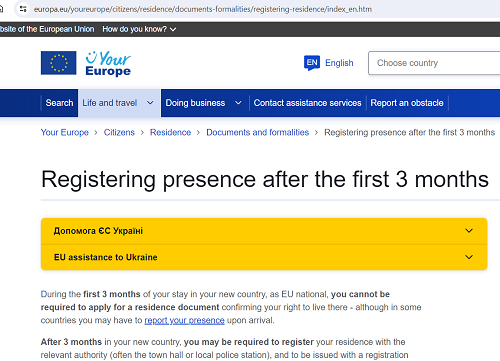
The European Union Citizen Registration Certificate (EURC) is a document required for citizens of the European Union (EU), the European Economic Area (EEA) and Switzerland who wish to reside in Portugal for a period of more than three months.
The citizen must present a list of documents, namely: document (passport or Citizen Card from an EU/EEA/Swiss country), proof of residence, proof of financial resources, etc.
The application must be made at the town hall where the citizen lives. In some cases, it is necessary to make an appointment.
Pay the fee for the CRUE application. The amount may vary, but it is generally an affordable fee.
In most cases, the EUCRC is issued on the same day.
Case study: An EU citizen enters Portugal and can stay for 90 days without the need for any kind of residence permit. If they wish to reside in Portugal, they will have 30 days to apply for a CRUE, counting from the end of the 90-day period.
Renewal: The CRUE is valid for 5 years and must be renewed at AIMA.
Authentication Certificate Requirements (United States of America)
Documents issued in the United States must be apostilled (apostila de haia) in order to be used in Portugal. Therefore, you don’t need to use any other type of authentication. In fact, Portugal does not accept any authentication other than the Hague Apostille.
However, if you are going to use the document issued in the United States in a country that is not part of the Hague Convention, then you must have it authenticated as explained below.
Before submitting documents to us, you must:
1) Get a notary public to notarize each document:
Using a county notary? Go to the clerk of court first and then a state office, such as a secretary of state. Using a state notary? Go to a state office, such as a secretary of state.
2) Make sure seals and signatures are originals
Get a certified copy from a notary public. A certified copy is a copy of a primary document with a certificate on it that it is the true copy. Get records, court documents, and federally-issued documents certified at the state level.
3) Get any documents in a foreign language translated into English. Get the translation notarized.
4) After you get your document(s) notarized, mail your Form DS-4194 and documents to us.
Requirements for Each Type of Document
State and Local Documents
Examples:
Birth certificates
Marriage certificates
Death certificates
Divorce decrees
Probate wills
Judgments
Your state and local documents must:
Be an original or certified document
Include the raised or stamped seal of the court or department of vital records
Be certified by the state which issued the documents. The secretary of state will certify to the official signing the document under the seal of the state.
What is the Criminal Record Certificate and how much does it cost?
It is a document that contains information about the criminal record of a person or company.
This document can be used for your own knowledge or to present to an entity when requested.
The certificate costs € 5.
What information can it contain?
Through the Criminal Record Certificate you can find out:
whether or not there are convictions in your name or the company you represent
which criminal conviction decisions are handed down by Portuguese or foreign courts in your name or the company you represent, which are communicated in accordance with international agreements
in the case of European Union citizens, it may also contain information about convictions in their country of nationality.
Who can apply for the Criminal Record Certificate?
Note: Our office provides a “declaration of authorization” template for the client to sign and authorize us to request the criminal record certificate on their behalf.
Any person, of any nationality, over 16 years of age, if it is their own registration.
Any person over the age of 18 can request the criminal record of another person, as long as authorized by the person. In this case, the request must be made in person and the authorization must be presented to the services.
In the case of a legal person, the request must be made by its legal representative.
Responsible Entity
The Directorate-General for the Administration of Justice (DGAJ) is a central service of the direct administration of the State.
Within the scope of its attributions, DGAJ is responsible, among others, for “ensure criminal identification”.
The organic unit of DGAJ responsible for issuing a criminal record certificate is the Directorate of Criminal Identification Services (DSIC).
Nossos serviços
Podemos pedir o seu certificado de registo criminal e, se necessário, apostilá-lo. Enviamos por correio para qualquer país.
In general, the terms “translator” and “interpreter” refer to different language professions.
A translator works with written text, translating written content from one language to another. Translators often have the opportunity to review and revise their work before it is finalized.
An interpreter deals with spoken words in real-time. Interpreters convey the spoken message from one language to another on the spot, without the luxury of reviewing or revising the content. Interpreting can be done in various settings, such as conferences, meetings, or live events.
In the scenario you described, where someone is speaking to an audience and another person is rendering the spoken words into another language, the second person would typically be referred to as an interpreter. They are providing real-time oral translation of the spoken words.
It’s worth noting that while the terms are often used distinctly, in some contexts, especially in colloquial language, people might use “translator” to refer to both translators and interpreters. However, in professional settings and within the language industry, the distinction between translation (dealing with written text) and interpretation (dealing with spoken words) is important.
interpreter (noun)
someone who translates for individuals or groups conversing in different languages
Adriano Martins Pinheiro is a writer, a certified translator in Portugal and lectures with interpreters from Portuguese into other languages.
translator (intransitive verb)
1: to practice translation or make a translation
Adriano Martins Pinheiro is a lawyer, writer, certified translator in Portugal and lectures with interpreters from Portuguese into other languages.
Our office does not offer relocation services. This text is only intended to clarify the meaning of this term.
The meaning of relocation
Relocation service providers in Portugal offer a range of services to individuals or businesses moving to or within the country. Their goal is to facilitate a smooth transition and help clients settle into their new environment. Here are some common services provided by relocation service providers in Portugal.
A warning
In Portugal, legal advice and/or consultation on visas or residence permits should only be provided by lawyers registered with the Portuguese Bar Association (OA).
Legal advice and/or consultation carried out by people who are not lawyers registered with the Portuguese Bar Association (OA) constitutes the crime of “procuradoria ilícita” (Law on Lawyers’ Own Acts | Law nº. 49/2004, of August 24).
1) Orientation Services
Area orientation: Familiarizing clients with different neighborhoods, schools, healthcare facilities, and other local amenities.
Cultural training: Offering insights into Portuguese culture, customs, and etiquette to ease the adjustment process.
2) Housing Support
Home search: Assisting in finding suitable accommodation based on the client’s preferences and budget.
In Portugal, the real estate consultant (or real estate agency) does the negotiation / intermediation. However, the drafting or analysis of the contract should be done by a lawyer.
3) School Assistance
School search: Assisting families in finding appropriate educational institutions for their children. Enrollment support: Helping with the enrollment process in local schools or international schools.
4) Settling-In Services
Utility connections: Assisting with setting up essential services like electricity, water, and internet. Local registration: Helping clients register with local authorities and obtain necessary identification documents.
5) Cultural and Language Support
Language training: Offering language courses or resources to help clients learn or improve their Portuguese language skills. Cultural integration: Providing guidance on cultural norms and helping clients integrate into the local community.
6) Spousal and Family Support
Career support for spouses: Assisting accompanying spouses in finding employment opportunities. Family services: Offering support for family members, including healthcare information and social activities.
7) Ongoing Support
Relocation support hotline: Providing a point of contact for ongoing assistance and addressing any issues that may arise after the initial move. Repatriation services: Assisting clients in the eventual return to their home country if needed.
These services are designed to alleviate the challenges associated with relocation and ensure a smoother transition for individuals or businesses moving to Portugal. The specific offerings may vary among different relocation service providers.
Conclusion
Therefore, the real estate consultant or real estate agent provides the service related to the search for and negotiation of real estate and the lawyer provides the service of legal advice and/or legal consultation, including the analysis or drafting of contracts.
As already mentioned, the aim of this text is to clarify the difference between relocation work, including the services of real estate agents, and the work of lawyers. We have chosen not to enter into partnerships with relocation service providers.
Autorización de residencia (certificado) para ciudadanos no europeos que deseen acompañar a un europeo (miembro de la familia) a Portugal por un período superior a tres meses.
Si es usted nacional de un tercer país y desea acompañar a su familiar nacional de la UE/EEE/Suiza a Portugal por un período superior a tres meses, solicite su
TARJETA DE RESIDENCIA PARA NACIONALES DE TERCEROS PAÍSES MIEMBROS DE LA FAMILIA DE NACIONALES DE LA UE/EEE/SUIZA
La Tarjeta de Residencia, que formaliza el derecho de residencia en Portugal, debe solicitarse si el familiar de un tercer país va a permanecer en Portugal más de tres meses.
El derecho de entrada, estancia y residencia en Portugal ampara a los ciudadanos de la Unión Europea (UE), del Espacio Económico Europeo (EEE) y de Suiza, así como a los miembros de su familia. Los miembros de la familia que sean nacionales de terceros países fuera de Portugal son admitidos en el país previa presentación de un pasaporte válido y sólo están sujetos a la obligación de visado de entrada en los términos de las normas vigentes en la Unión Europea. Por lo tanto, antes de entrar en territorio nacional, deben dirigirse a la oficina consular portuguesa/misión consular en el extranjero para validar los requisitos necesarios.
¿Quién puede solicitarlo?
Un miembro de la familia de un ciudadano de la Unión Europea, Islandia, Liechtenstein, Noruega, el Principado de Andorra y Suiza que sea nacional de un tercer país si
Cónyuge;
Descendiente hasta la edad de 21 años;
Descendientes mayores de 21 años a cargo del titular del derecho;
Ascendientes a cargo del titular del derecho.
¿Dónde se puede solicitar?
En los mostradores de atención al público del SEF (AIMA), previa cita a través del centro de atención telefónica.
¿Cuándo puedo presentar la solicitud?
Dentro de los 30 días siguientes a los tres meses de entrada en territorio nacional, previa cita.
La documentación requerida varía según los casos. Si falta algún documento, no se aceptará la solicitud.
Si tiene dudas sobre el procedimiento y/o los documentos exigidos, solicite asesoramiento jurídico a un abogado inscrito en el Colegio de Abogados portugués.
Si vous êtes un ressortissant d’un pays tiers et que vous souhaitez accompagner un membre de votre famille ressortissant de l’UE/EEE/Suisse au Portugal pour une période de plus de trois mois, veuillez demander votre
CARTE DE SÉJOUR POUR LES RESSORTISSANTS DE PAYS TIERS MEMBRES DE LA FAMILLE DE RESSORTISSANTS DE L’UE/EE/SUISSE
La carte de séjour, qui formalise le droit de séjour au Portugal, doit être demandée si le membre de la famille ressortissant d’un pays tiers séjourne au Portugal pendant plus de trois mois.
Le droit d’entrer, de séjourner et de résider au Portugal s’applique aux citoyens de l’Union européenne (UE), de l’Espace économique européen (EEE) et de la Suisse, ainsi qu’aux membres de leur famille. Les membres de la famille qui sont des ressortissants de pays tiers au Portugal sont admis dans le pays sur présentation d’un passeport en cours de validité et ne sont soumis à l’obligation de visa d’entrée qu’en vertu des règles en vigueur dans l’Union européenne. Par conséquent, avant d’entrer sur le territoire national, ils doivent se rendre au poste consulaire portugais/à la mission consulaire à l’étranger afin de valider les conditions requises.
Qui peut présenter une demande ?
Les membres de la famille des citoyens de l’Union européenne, de l’Islande, du Liechtenstein, de la Norvège, de la Principauté d’Andorre et de la Suisse qui sont ressortissants de pays tiers si:
Conjoint ;
Descendant jusqu’à l’âge de 21 ans ;
Descendants âgés de plus de 21 ans à la charge du titulaire du droit ;
Ascendants à charge du titulaire du droit.
Où puis-je déposer ma demande ?
Aux guichets de service du SEF (AIMA), sur rendez-vous préalable auprès du centre d’appel.
Quand puis-je déposer ma demande ?
Dans les 30 jours ou les trois mois suivant l’entrée sur le territoire national, sur rendez-vous préalable.
Les documents requis varient selon les cas. Si un document manque, la demande ne sera pas acceptée.
Si vous avez des doutes sur la procédure et/ou les documents requis, demandez conseil à un avocat inscrit au barreau portugais.
Si es usted ciudadano de la UE/EEE/Suiza y tiene intención de permanecer en Portugal más de tres meses, solicite su
CERTIFICADO DE REGISTRO PARA CIUDADANOS DE LA UE/EEE/SUIZA
De acuerdo con la Ley nº 37/2006, de 9 de agosto, los nacionales de todos los países de la Unión Europea (UE) que viajen o residan en Portugal, así como los familiares que los acompañen o se reúnan con ellos, gozan del derecho de entrada, estancia y residencia en Portugal, al igual que los miembros de los Estados parte del Espacio Económico Europeo (Islandia, Liechtenstein, Noruega), el Principado de Andorra y Suiza y sus familiares, así como los familiares de los nacionales, independientemente de su nacionalidad.
El Certificado de Registro, que formaliza el derecho de residencia en Portugal, debe solicitarse si el ciudadano de la UE/EEE/Suiza va a permanecer en el país más de tres meses. Hasta entonces, sólo necesitan tener un documento de identidad o pasaporte en vigor.
El derecho de entrada, estancia y residencia en Portugal ampara a los ciudadanos de la Unión Europea (UE), del Espacio Económico Europeo (EEE), del Principado de Andorra y de Suiza, así como a los miembros de sus familias.
¿Quién puede solicitarlo?
Los ciudadanos de la Unión Europea, Islandia, Liechtenstein, Noruega, el Principado de Andorra y Suiza.
¿Cuándo puedo presentar la solicitud?
Dentro de los 30 días siguientes a su entrada en Portugal.
Si tiene dudas sobre el procedimiento y/o los documentos necesarios, solicite asesoramiento jurídico a un abogado inscrito en el Colegio de Abogados portugués.
Si vous êtes un citoyen de l’UE/EEE/Suisse et que vous avez l’intention de séjourner au Portugal pendant plus de trois mois, demandez votre
CERTIFICAT D’ENREGISTREMENT POUR LES CITOYENS DE L’UE/EE/SUISSE
Conformément à la loi n° 37/2006 du 9 août, les ressortissants de tous les pays de l’Union européenne (UE) qui voyagent ou résident au Portugal, ainsi que les membres de leur famille qui les accompagnent ou les rejoignent, jouissent du droit d’entrée, de séjour et de résidence au Portugal, tout comme les membres des États parties à l’Espace économique européen (Islande, Liechtenstein, Norvège), de la Principauté d’Andorre et de la Suisse et les membres de leur famille, ainsi que les membres de la famille des ressortissants, quelle que soit leur nationalité.
Le certificat d’enregistrement, qui officialise le droit de séjour au Portugal, doit être demandé si le citoyen de l’UE/EEE/Suisse séjourne dans le pays pendant plus de trois mois. Dans l’intervalle, il lui suffit d’être en possession d’une carte d’identité ou d’un passeport en cours de validité.
Le droit d’entrée, de séjour et de résidence au Portugal s’applique aux citoyens de l’Union européenne (UE), de l’Espace économique européen (EEE), de la Principauté d’Andorre et de la Suisse, ainsi qu’aux membres de leur famille.
Qui peut déposer une demande ?
Les citoyens de l’Union européenne, de l’Islande, du Liechtenstein, de la Norvège, de la Principauté d’Andorre et de la Suisse.
Si vous avez des doutes sur la procédure et/ou les documents requis, demandez l’avis d’un avocat inscrit au barreau portugais.
We apostille in Portugal and send the apostilled document by post to all countries. The entire procedure is online. The client places the order, makes the payment and informs us of the address where they wish to receive the document by post.
Sending procedure:
1) The client provides the details (or a copy) of the document they want apostilled (e.g. birth certificate, marriage certificate, death certificate, criminal record, etc.); 2) The firm makes an estimate and sends a signed fee proposal to the client; 3) The client signs the proposal and sends it by e-mail (in pdf) and then makes the payment; 4) The firm asks DHL for a quote for sending the document to the client’s address; 5) The firm informs the client of DHL’s quote; 6) The client makes the payment for the document to be sent by DHL. 7) Once payment has been confirmed, the firm sends the document to the address provided by the client.
Apostille of marriage, divorce and death certificates.
In order to request that a marriage, divorce or death certificate be apostilled, we need full details. If the person concerned has a copy of the register, they can send it to us by email or WhatsApp.
Let’s explain how apostille works in Portugal. As an example, for marriage, divorce and death certificates, we need to:
1º) apply for the seat to be issued (2nd copy); 2º) request the certification of the respective seat; 3º) remove the certified seat and send it for apostille.
The procedures are carried out in two stages. The seat is issued and certified at the IRN and the apostille is done at the Court. Both services require prior appointment.
Fees charged by the Portuguese Government
You will need to pay three fees for the public service:
a) fee for issuing the document (e.g. birth certificate); b) fee for certifying the document; c) the fee for apostilling the document.
In addition, it is worth remembering that the client will have to pay the post office fee for sending the apostilled document. Our suggestion is that the client opts for DHL.
Postage costs
The firm sends the apostilled document to the address requested by the client. This is sent by DHL.
When the firm has the document in its hands, it requests a quote for shipping and informs the client. There is no way for the firm to know the cost of the shipment before receiving the quote from DHL. If the client wishes, they can make a simulation on the DHL website to get an idea of the approximate cost. The price takes into account the distance and weight of the envelope.
The client must pay for the document to be sent. The office will send the receipt to DHL as soon as payment has been made.
Region of apostille
We apostille any public document issued in Portugal (in any region of Portugal).
How long does apostille take?
The office needs to make:
an appointment to issue the birth / marriage or death certificate.
another appointment for the respective apostille.
As a rule, the office carries out the apostille within 2 working days from the date of payment confirmation (the date on which the payment becomes available in our bank account).
When the document is apostilled, the office calculates and informs you of the cost of sending the document. The shipping procedure begins as soon as payment has been made.
Document search
There are cases in which the client needs a certain seat apostilled but doesn’t have it. In this case, it is necessary to carry out a search and, once found, carry out the apostille procedure above.
The search service has a cost that can be added to the apostille service.